In the market for a new data science-machine learning (DSML) platform? The folks over at Gartner have put together a document that ranks the top DSML platform providers in the business. Databricks took home the number one slot this year after sharing it last year with Microsoft and Google.
For its 2025 Magic Quadrant for DSML platforms, Gartner analysts Afraz Jaffri, Maryam Hassanlou, Tong Zhang, Deepak Seth, and Yogesh Bhatt sliced and diced 16 DSML offerings, which are loaded with generative AI and agentic AI capabilities.
Instead of conducting advanced analytics or using classical machine learning algorithms to build models atop tabular data, the typical DSML platform user today is tapping into the power of large language models (LLMs) and other foundation models to automate business tasks, according to Gartner, which says a recent survey found more than half of DSML users are using AI functions to gain automated insights or using natural language queries to develop AI.
Building and evaluating AI and ML models remains a core focus for the DSML platforms evaluated by Gartner, which must work with structured and unstructured data. Other common features include: inclusion of data prep capabilities; code-based development environment; collaboration and project management features; deployment and hosting options; model lifecycle management; and advanced administrative control over users.
One of the areas where the DSML platforms differ is the inclusion of foundation models. Google, Microsoft, Amazon Web Services, Alibaba, and IBM build their own foundation models. Databricks, a leader in the 2025 Magic Quadrant for DSML platforms, previously developed its own models but now is focused on enabling its customers to make the most of others’ models.
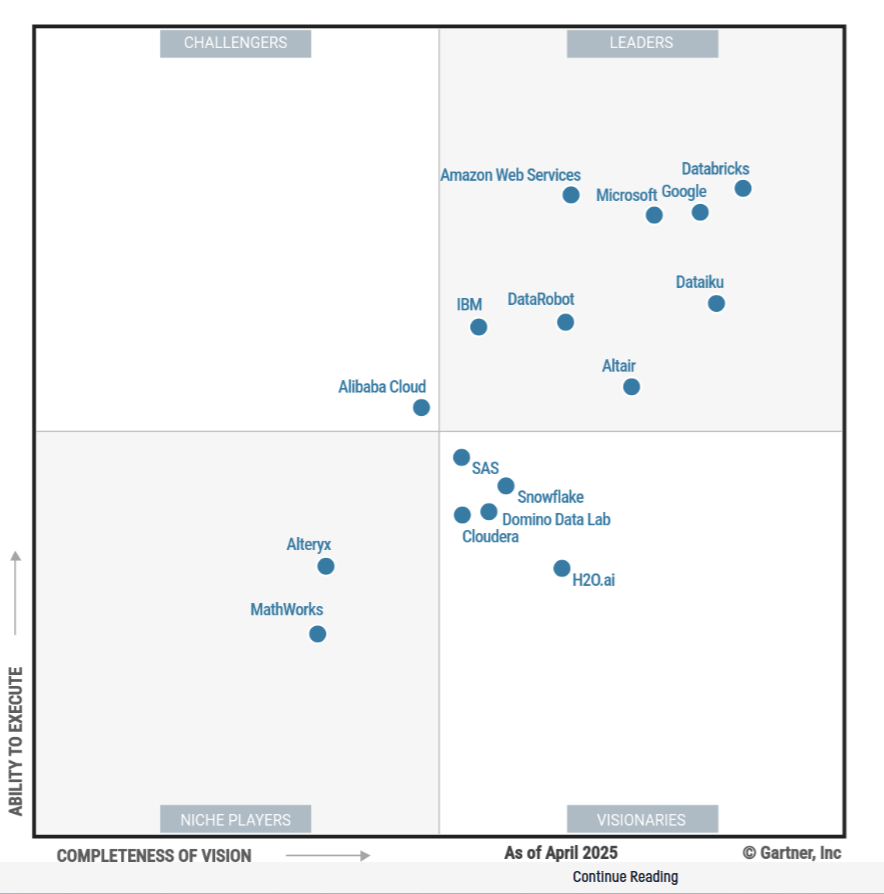
Gartner 2025 Magic Quadrant for Data Science Machine Learning Platforms (Source: Gartner)
There’s plenty of work to go around even without developing one’s own foundation models. As the analysts note: “GenAI is a significant catalyst, but the challenge of integrating data, models, code and infrastructure into reliable, scalable products remains. In addition, composite AI systems that combine predictive and generative models will become a standard methodology for AI development, further cementing the importance of a DSML platform.”
Leaders Quadrant
Databricks owned the top spot in this Magic Quadrant on the back of a “comprehensive” platform, stabled leadership, and continued market success. The company had the highest rating on the vertical “ability to execute” scale last year, and this year, it added the highest score along the horizonal “completeness of vision” ranking, overtaking Microsoft, Google, and Dataiku. A sometimes-steep learning curve, improved competitive offerings, and the lack of availability of some features on different cloud platforms were concerns listed by Gartner.
Google grabbed the number two spot with its Vertex AI platform, which Google notes is integrated with the Gemini family of foundation models. Core Google strengths include unified governance in Vertex AI, RAG support in Vertex AI Search, and a history of co-innovation with its customers. Complexity of Vertex AI, support for Vertex AI outside of Google, and the existence of other RAG solutions are cautions.
Microsoft rounded out the top three finishers with its Azure ML offering, which Gartner hailed for providing a range of capabilities for data scientists, AI engineers, and “pro-code developers.” The analyst firm was impressed with Azure AI Foundry’s experimentation features, a robust ecosystem, and flexible pricing. Concerns include the diminishing performance gap with partner OpenAI’s models, limited availability of Microsoft Copilot, and confusing branding.
Amazon Web Services is also near the top thanks to its SageMaker line of tools and its Bedrock foundation models. Gartner plusses include the launch of AWS’s unified SageMaker Unified Studio in December, a robust AI app ecosystem, and responsible AI capabilities. Cautions include integration and flexibility, lack of use of AWS’s foundation models, and monitoring spending and forecasting usage.
Dataiku leads a second tier of DSML offerings within the Leaders Quadrant that offer similar completeness of vision but don’t have the ability to execute of the cloud bigs above. The French-American company was hailed by Gartner for its continued focus on data science, customer support, and market understanding. Cautions include concerns over features delivery, buyer awareness, and differentiation with other DSML vendors.
Altair has continued to build on its RapidMiner offering, which it acquired in 2022. Gartner ranked Altair’s market understanding as high, launded the acquisition and integration of Cambridge Semantics’ knowledge base offering earlier this year, and also mentioned its AI Centre of Excellence. Concerns include customer awareness, integration challenges, and uncertainty following the acquisition of Altair by Siemens in March.
Databricks has the top-rated DSML platform, per Gartner (Tada Images/Shutterstock)
DataRobot got a boost in the Gartner rankings thanks to a refresh its product and a pivot to AI in 2024 that “resonates with the needs of enterprises.” The analyst firm also applauded DataRobot’s acquisition of Agnostiq and its overall market understanding. Cautions include public perception of DataRobot as being poorly suited for experts, difficulty managing the low-code and pro-code interactions, and getting buy-in from other partners and vendors.
IBM moved further right in this year’s Magic Quadrant on the back of watsonx, which Gartner hailed for providing a wide range of tools, open frameworks, and foundation models. The acquisition of DataStax also bolstered IBM’s standing in Stamford, Connecticut, while IBM Research provides good stuff from the lab. Concerns include awareness of the Granite models, the exclusion of SPSS tools within watxonx, and lower integration levels when being used in AWS, Azure, and GCP.
Visionaries Quadrant
H2O.ai had the most complete vision of any vendor in the Visionaries Quadrant. Gartner hailed the firm’s “specific expertise” in using small language models, fine-tuning, distillation, vector search, and AI agent creation. Integration of predictive AI capabilities and access to 24 Kaggle Grandmasters were plusses. Minuses include pricing that can be difficult to understand, market awareness, and lack of consultants in the partner roles.
Snowflake made its debut in the DSML Platform report this year with its cloud-based offering that’s widely adopted across midsize and large enterprises. Gartner applauded Snowflake for its strong vision for combining structured and unstructured data, its AI apps marketplace, and training programs. Concerns include a complex pricing scheme, limited geographic availability of some AI models, and MLOps capabilities that have been slow to arrive.
Domino Data Lab moved slightly to the right in this year’s DSML report. Gartner likes Domino’s evolution of the governance solution to handle risk and compliance, as well as its industry focus and integration of FinOps capabilities. Concerns include limited awareness, lack of features for data engineers, and complex integrations.

(kurhan/Shutterstock)
Cloudera barely moved in the Visionaries Quadrant with its unified open data lakehouse and data fabric offering. Gartner likes two Cloudera acquisitions, of Verta and Octopai, as well as its support for private AI running on-prem or in the cloud. It also likes the integration with Hugging Face and Nvidia NGC model registries. Cautions include market awareness, the complexity of open source frameworks, and less sophisticated AI governance capabilities than competitors.
SAS made its debut in the Visionaries Quadrant after being in the Leaders Quadrant last year. The vendor’s Viya offering was hailed for having a composable architecture that gave customers flexibility and choice, as well as its risk management offerings for companies in regulated industries. SAS’s partnership with Microsoft was also a plus. Minuses include an agentic AI vision that lags its peers, lower adoption of Viya, and competition from other DSML vendors.
Challengers Quadrant
Alibaba Cloud is the lone occupant of the Challengers Quadrant, which in 2024 also included IBM. The Chinese cloud giant’s Cloud Platform for AI (or PAI) checks a lot of boxes when it comes to high performance computing resources and data science infrastructure, not to mention Alibaba’s $53 billion investment in AI infrastructure. The availability of Alibaba’s Qwen models, solid security, and LLM inference accelerators were pluses. Cautions include low adoption outside of Southeast Asia, too much focus on the retail industry, and an unclear data science strategy.
Niche Players Quadrant
Alteryx is looking to reinvent itself following the launch of Alteryx One Platform earlier this year and the sale of the once public company to private equity firms in 2024. Gartner hailed the broad appeal of the Alteryx platform, its focus on data, and flexibility. Concerns include executive transitions of 2024, not enough traction among code-first users, and GenAI innovations for data scientists.
MathWorks is also listed in this year’s MQ thanks to its MATLAB and Simulink products, which are widely used by data scientists, engineers, others in industrial sectors, like automotive, aerospace, industrial automation, telecommunications and medical devices. AI and simulation are strengths of the MathWorks products, wide talent availability, and understanding of non-LLM AI agent use cases. Concerns include too much focus on data scientist personas, a lack of GenAI capabilities, and no private cloud offering.
There were three vendors dropped from this year’s MQ for DSML, including Anaconda, KNIME, and Posit (formerly RStudio).
Related Items:
Cloud Giants Gain with DSML Platforms, While GenAI Fans the Flame: Gartner
A ‘Glut’ of Innovation Spotted in Data Science and ML Platforms
Data Science and ML Platform Market Heats Up
The post Databricks Takes Top Spot in Gartner DSML Platform Report appeared first on BigDATAwire.


0 Commentaires