At this year’s Accelerate event in Las Vegas, Pure Storage laid out an ambitious direction for enterprise infrastructure. The company is building on its reputation for high-performance storage with a broader focus on unified data management across hybrid setups and AI-driven workloads.
The Santa Clara–based company introduced its Enterprise Data Cloud (EDC) platform, designed to help organizations manage object, block, and file workloads across cloud, on-premises, and hybrid environments. The company also announced upgrades to its FlashArray and FlashBlade lines, targeting the kind of performance AI and analytics workloads increasingly demand.
Pure Storage is best known for its flash-based storage systems, built to deliver high performance with less complexity than traditional enterprise infrastructure. Over the years, it has leaned into software and automation to help organizations manage growing data demands without expanding operational overhead.
EDC runs on Pure Fusion and integrates with Pure1 to simplify storage management. It takes care of provisioning automatically, applies policies across systems, and helps teams keep things running smoothly as data needs grow.
The launch of EDC signals a clear shift in how Pure Storage thinks about storage. Rather than managing arrays one by one, the platform treats them as part of a single, connected system. It brings everything under one set of policies, using automation to keep things running smoothly—even as environments grow more complex and spread across cloud and on-prem systems.

(pathdoc/Shutterstock)
“In an era where data is king and IT complexity remains a major hurdle to accessing and using data for optimal business value, Pure Storage is once again redefining what’s possible for customers,” said John Colgrove (Coz), Founder and Chief Visionary at Pure Storage.
EDC is designed to ease some of the routine challenges IT teams face when managing storage across complex environments. The workflow automation tools allow teams to use predefined settings instead of configuring systems manually. The AI features are meant to help, not replace, by offering real-time suggestions and generating scripts based on live data. These additions won’t eliminate effort, but they could reduce the time teams spend on repetitive tasks.
Pure Storage CEO Charlie Giancarlo positioned the announcement as a response to what many enterprise customers are starting to realize—that the success of AI depends less on raw processing power and more on how effectively data is governed, accessed, and put to use.
Alongside its platform ambitions, Pure Storage also refreshed its hardware portfolio with a focus on performance, consolidation, and future workloads. The latest FlashArray//XL, a high-end model in the FlashArray family, is aimed at customers running dense, mission-critical environments, offering more throughput and storage capacity without requiring more rack space. That balance of power and efficiency continues to be a priority for organizations looking to scale without adding complexity to already stretched infrastructure.
FlashBlade received a performance upgrade as well. The system is now better equipped to handle unstructured data workloads such as AI pipelines, genomic analysis, and large-scale simulations. These are scenarios that demand both speed and scale.
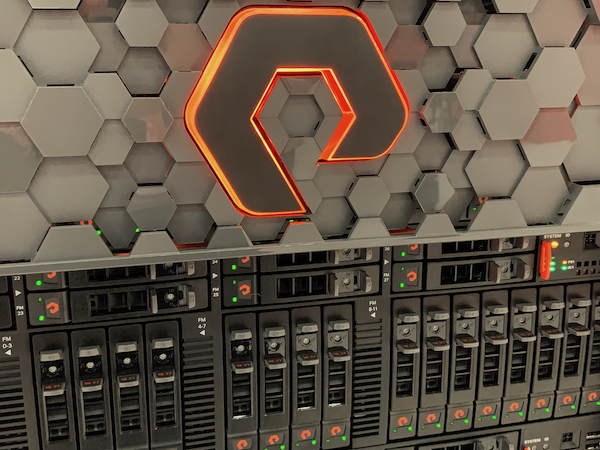 Meanwhile, Pure Storage has extended object storage support across the broader FlashArray line, allowing customers to manage block, file, and object data within a single system. It’s a subtle but meaningful shift that helps reduce infrastructure sprawl. As enterprise environments grow more complex, this kind of architectural consolidation supports the larger goals of the EDC.
The announcements by Pure Storage reflect a broader shift in enterprise infrastructure. Performance and capacity remain important, but they are no longer the primary focus. The real competition is about control. Vendors are racing to help organizations manage data more intelligently across hybrid environments.
Several major players are pursuing similar goals through different strategies. NetApp promotes ONTAP as a foundation for managing data across on-premises and cloud environments. Dell has been expanding its APEX offerings, aiming to streamline how enterprises consume infrastructure. HPE, through its GreenLake platform, focuses on delivering IT as a service with a cloud-like experience across the entire stack.
Pure Storage is trying to differentiate itself from competitors by more tightly integrating storage, software, and automation. EDC is not just another product layer, but it is part of a larger effort to rethink how these systems interact within the enterprise stack.
A more integrated approach may appeal to IT teams under pressure to simplify operations and manage growing data demands. However, Pure Storage will still face practical hurdles. Lock-in remains a concern, especially for organizations that rely on multi-vendor systems. Just as critical is whether the new platform model and hardware updates can fit into existing environments without disrupting how teams already operate. If Pure Storage can overcome these obstacles, it could strengthen its position in a competitive market.
The post Pure Storage Unveils Enterprise Data Cloud to Unify Storage and Data Management appeared first on BigDATAwire.





0 Commentaires