Across research labs, structured data keeps piling up—spreadsheets filled with results, logs from instruments, tables that grow with every project. Much of it never gets fully explored because the analysis takes time and often requires specialized skills. Science has the data, but it doesn’t always have a straightforward or efficient way to listen to what it’s saying.
The Allen Institute for AI (Ai2) is tackling that problem with a new tool called Asta DataVoyager. Instead of depending on complex scripts or custom workflows, it lets scientists query datasets in plain language and get back answers that include visualizations, code they can run themselves, and a documented record of the steps taken. The goal is less about flash and more about making analysis transparent and reproducible.
Asta DataVoyager breaks each request into a series of steps that form a running record of the analysis. When a researcher asks a question, the system adds the result to that record, and any follow-up changes are saved in sequence. If a researcher wants to try a new test or handle outliers differently, those edits don’t erase what came before. They’re added on, so the record shows each step as the work builds. Over time, the report creates a trail—what was asked, what was changed, and what held up. That kind of history makes it easier for colleagues or reviewers to follow the reasoning and judge the work for themselves.

(kmlmtz66/Shutterstock)
Ai2 CEO Ali Farhadi said the aim is to make sure scientists can lean on the system without losing confidence in what it produces. “AI can only accelerate science if it is as rigorous and transparent as science itself,” he said.
The Allen Institute for AI was founded in 2014 by Microsoft co-founder Paul Allen with the mission of pushing artificial intelligence in ways that serve science and society. Since then, the nonprofit has released open models and research platforms built to make AI more accessible outside the tech industry.
Asta DataVoyager is the latest step in that effort, and its first major test comes in a high-stakes setting: cancer research. Through the Cancer AI Alliance (CAIA), four leading centers are piloting the system to analyze de-identified patient data across institutions, looking for insights into treatment outcomes that would be difficult to surface with traditional methods.
Jeff Leek, chief data officer at Fred Hutch and scientific director of the alliance, said the real promise is giving clinicians a tool they can use directly. “When I think about the future of where I want it to go, I think about this tool in the hands of clinicians, helping to answer important questions that will ensure the best possible care for cancer patients,” he said.
What makes the CAIA project notable is the way the data is handled. Instead of pooling patient records in a single location, the alliance uses a federated approach: the models move to each cancer center, learn from local information, and return only aggregated results. Individual records never leave institutional walls. For clinicians, this means they can draw on a wider base of evidence without compromising patient privacy, a requirement that has often slowed progress in cross-institution studies.
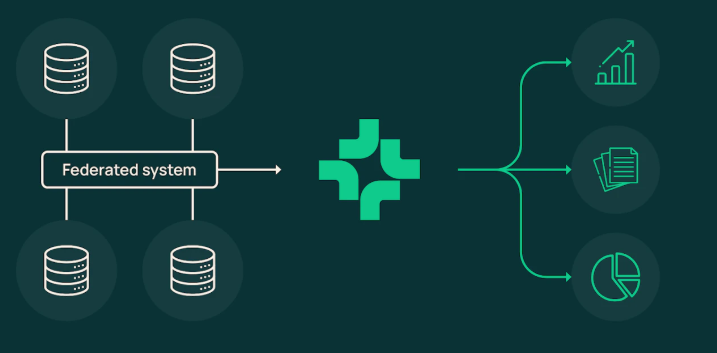
Credits: allenai.org
One of the first studies under way looks at lung cancer treatments. Researchers are looking at how patients respond under different treatment plans. They’re studying questions like how long to wait before surgery after chemo-immunotherapy, what happens when immunotherapy is added after radiation, and whether targeted drugs improve survival compared with standard platinum chemotherapy. These kinds of comparisons often need data from several hospitals, which is why they’re so hard to do with older methods.
Outside the alliance, the Paul G. Allen Research Center at Swedish Cancer Institute is also testing DataVoyager. There, the focus is on giving physicians with limited data-science training a way to ask their own questions of structured health records. If these pilots succeed, Ai2’s tool could mark a step toward making complex data analysis routine in everyday scientific practice.
Earlier this year, the National Science Foundation and NVIDIA pledged $152 million for a project run by the Allen Institute for AI called Open Multimodal AI Infrastructure. The aim is to create fully open models that can work across different types of data, from text to images, and make them available for scientific use. For Ai2, it’s another way of backing its core belief that openness drives progress. The same idea runs through DataVoyager—giving researchers tools that make data simpler to work with, easier to share with others, and reliable enough to build on in serious research.
Related Items
Data is at the Center of Scientific Discovery Inside MIT’s New AI-Powered Platform
NASA’s Metadata Project Expands Access to Critical Science Data
Sphinx Emerges with Copilot for Data Science
The post Ai2’s DataVoyager Lets Scientists Talk to Their Data appeared first on BigDATAwire.





0 Commentaires